On 20–22 May 2026, RIPE NCC members will vote on the charging scheme for 2027, at the General Meeting in Edinburgh and remotely. There are two options.
Option A keeps the current flat-fee model. Every LIR account pays the same yearly fee. The fee goes from €1,800 to €1,894. The €50 fee per additional ASN and the €75 fee per PI or legacy resource stay in place.
Option B is a category model. LIRs are split into 21 categories based on the amount of PA IPv4 and IPv6 they hold. The lowest category pays €500 per year, the highest pays €39,864. We counted from the current RIPE database: about 75% of LIR accounts would pay less under Option B than under Option A. PI and legacy resources are not counted toward the category. The RIPE NCC also provides a pricing calculator for both options.
We are asking LIRs to vote for Option B, as that would allow us and many other small organizations to exit the sponsoring scheme to become full LIRs, with the rights and duties associated.
A short glossary #
- RIPE NCC is the Regional Internet Registry for Europe, the Middle East and parts of Central Asia. It hands out IP addresses and Autonomous System Numbers (ASNs).
- LIR (Local Internet Registry) is an organization that holds resources directly from RIPE NCC, pays a yearly fee, and can sub-assign address space to its own customers. Only LIR accounts can vote at the General Meeting.
- ASN (Autonomous System Number) is a number that identifies a network on the public internet for routing purposes (BGP). Ours is 214094.
- PA (Provider Aggregatable) is address space that an LIR holds from RIPE NCC and sub-assigns to its customers. If the customer leaves, they lose the addresses.
- PI (Provider Independent) is address space assigned to an end-user directly. The end-user keeps it even if they change network provider.
- Sponsoring LIR is an LIR that signs the contract with RIPE NCC on behalf of an end-user who holds PI resources or a sponsored ASN. The end-user is the actual holder, pays the LIR, but does not vote.
- Legacy resources are IP blocks and ASNs assigned before RIPE NCC existed in its current form.
Why we care #
We became AS214094 thanks to a sponsoring LIR that took us on for free, though they started incurring costs, like many others, since the RIPE NCC started charging for sponsored ASNs and raised the fee on Legacy or PI resources. The base LIR fee was €1,400 until 2022, €1,550 in 2023–2024, €1,800 in 2025–2026, and €1,894 if Option A passes.
We counted sponsored objects in historical RIPE database snapshots. Sponsored IPv4 PI and legacy registrations dropped from 15,949 in 2018 to 13,613 today. Sponsored ASNs took a sharp dip in January 2025, the month the new per-ASN fee took effect.
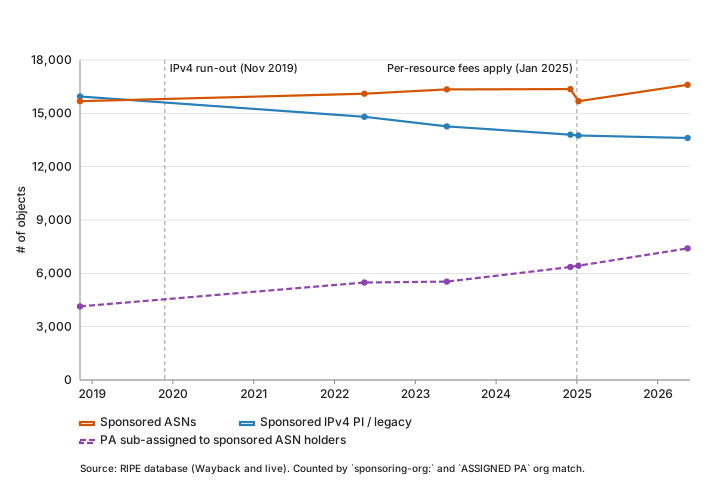
We believe the divergence is an increase in the IPv4 leasing market. Operators still want their own ASN, so the network identity is still being registered. However, due to RIPE policies, IPv4 PI assignments are harder and harder to obtain, and are almost absent from the secondary market. Sponsored IPv6 PI assignments grew over the same period, so the decline is specifically about IPv4 scarcity, not about operators losing interest in registering their own resources.
Leasing itself is not recorded in the RIPE database, but the dashed line in the chart is the closest extrapolation we could build from RIPE data: sponsored ASN holders that also hold ASSIGNED PA sub-assigned to them by another LIR: upstream allocations, IPv4 brokers, and leasing platforms all roll into this category. The count of such sub-assignments grew from 4,140 in 2018 to 7,405 today (+79%).
IPv4 PI assignments are closed. The €50 per-PI fee has been in place since 2011 and was raised to €75 in 2025, the same year the new €50 per-ASN fee was introduced. It was already expensive to join the registry, but more than that, it is increasingly difficult to have long-term IPv4 assignments that are not subject to someone else’s conditions, termination, or reputation checks. And those most directly impacted by these decisions, sponsored end-users and PI holders, do not have a vote at the General Meeting.
Why this matters for Tor and small operators #
Running Tor relays on commercial providers has always been difficult. Many providers will take nodes down based solely on abuse complaints, often automated, often based on spoofed traffic as we wrote in 2024. For exits (but also in other circumstances), leasing is extremely hard: since IPv4 ranges lose value as complaints damage their reputation, most marketplaces let the lessor terminate the agreement in such cases.
Even when an operator manages to lease, they then pay rent indefinitely instead of owning the resource, which over a network’s lifetime is the more expensive option. Leased ranges are also less stable: the lessor can pull the range back with notice. Many hosting providers themselves now lease their IPv4 from the same marketplace, so when one customer’s Tor relay damages a range shared with their other customers, the relay is the easier thing to drop. The deterrent effect is more noticeable on politically sensitive infrastructure.
Owning your own ASN and address space is the only stable answer. The routes to get there, become an LIR, or find a sponsor, are precisely the ones getting more expensive. Option A makes both routes even less accessible. Option B makes the LIR route accessible for the first time in years for a small operator.
A progressive scheme is the obvious answer #
The bill should be paid in proportion to how much of the limited resource a member holds. This is the standard logic of progressive taxation. Option B applies it to the registry of network resources.
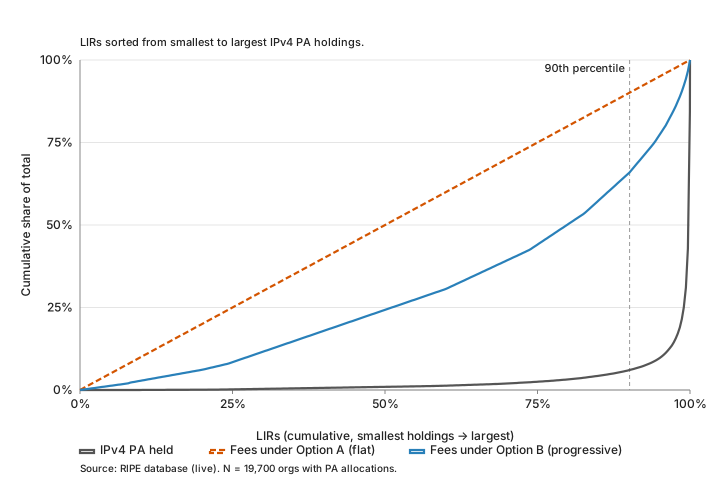
The redistribution is mostly symbolic for the LIRs paying less: the 75% who save under Option B together hold only 2.3% of the PA IPv4 in the RIPE region. However, at the top about 10% of LIRs hold 94% of all PA IPv4. These are the LIRs whose fee more than doubles under Option B — starting at €4,335/year, from a /18 (16,384 addresses) and up.
A note on governance #
A member of ours has attended a RIPE meeting, and that led us to believe the event is not necessarily representative of the wider internet community that depends on these decisions.
A progressive charging scheme will not fix that on its own, but it lowers the entry barrier. At a €500 minimum, the LIR system becomes affordable for entities that are not running a commercial business: civil-society projects, nonprofits, collectives, and public-interest infrastructure. Each one of them at the table would help change some of the dynamics at the General Meeting, distribute the power inside the registry, and make advocacy easier.
What you can do #
If you are an LIR, register for the General Meeting and vote Option B, in Edinburgh or remotely, and if you cannot vote, share this.
Correction (18 May 2026): an earlier version of this post stated that the per-ASN and per-PI fees were both introduced in 2025. In fact, the €50 per-PI fee has existed since 2011; in 2025 it was raised to €75. The LIR fee timeline has also been clarified, and two references to “RIPE” have been corrected to “RIPE NCC”.
Update (22 May 2026): the voting report is out and, unfortunately, Option A has won by few votes: 1,547 (51.12%) to 1,479 (48.88%), a margin of just 68. Turnout was extremely low: 3,049 ballots cast out of 20,717 eligible LIR accounts (as of March 2026), around 15%.